Learning in the Flow of Work: Why Traditional Training Is Dying
For decades, workplace training followed roughly the same script: pull people out of their jobs, sit them in a room for a few hours (or a few days), and hope that what they absorbed would somehow show up in their work afterward.
Sometimes it did. More often, it didn't, and most of us have sat through enough of these sessions to know it.
The world the workplace operates in now looks nothing like the one that training model was built for, but a lot of organisations are still running the old playbook anyway.
Here's the blunt version: training built for a slower era can't keep up with how fast business actually moves now. Remote teams, shifting priorities, and a calendar that's already full leave almost no room for the old "stop everything and learn" approach.
What works instead is learning that shows up where the work already is.
Why the Old Model Breaks Down
Traditional training assumes people have slack in their schedule to step away and absorb something new. Most professionals don't. They're juggling a packed inbox, back-to-back meetings, and a to-do list that grows faster than it shrinks.
So when someone finally gets back to their desk after a full-day workshop, they're not thinking about what they just learned: they're triaging the 200 unread messages waiting for them. And this tracks with something most of us already know: if you don't use new information quickly, you lose most of it.
It's not that people don't want to learn. It's that the learning usually happens too far removed from the moment they'd actually need it. Teach someone a skill in March that they won't use until June, and June-you is starting from scratch.
What "Learning in the Flow of Work" Actually Means
The idea is pretty literal: instead of stopping work to learn, learning becomes part of the work itself.
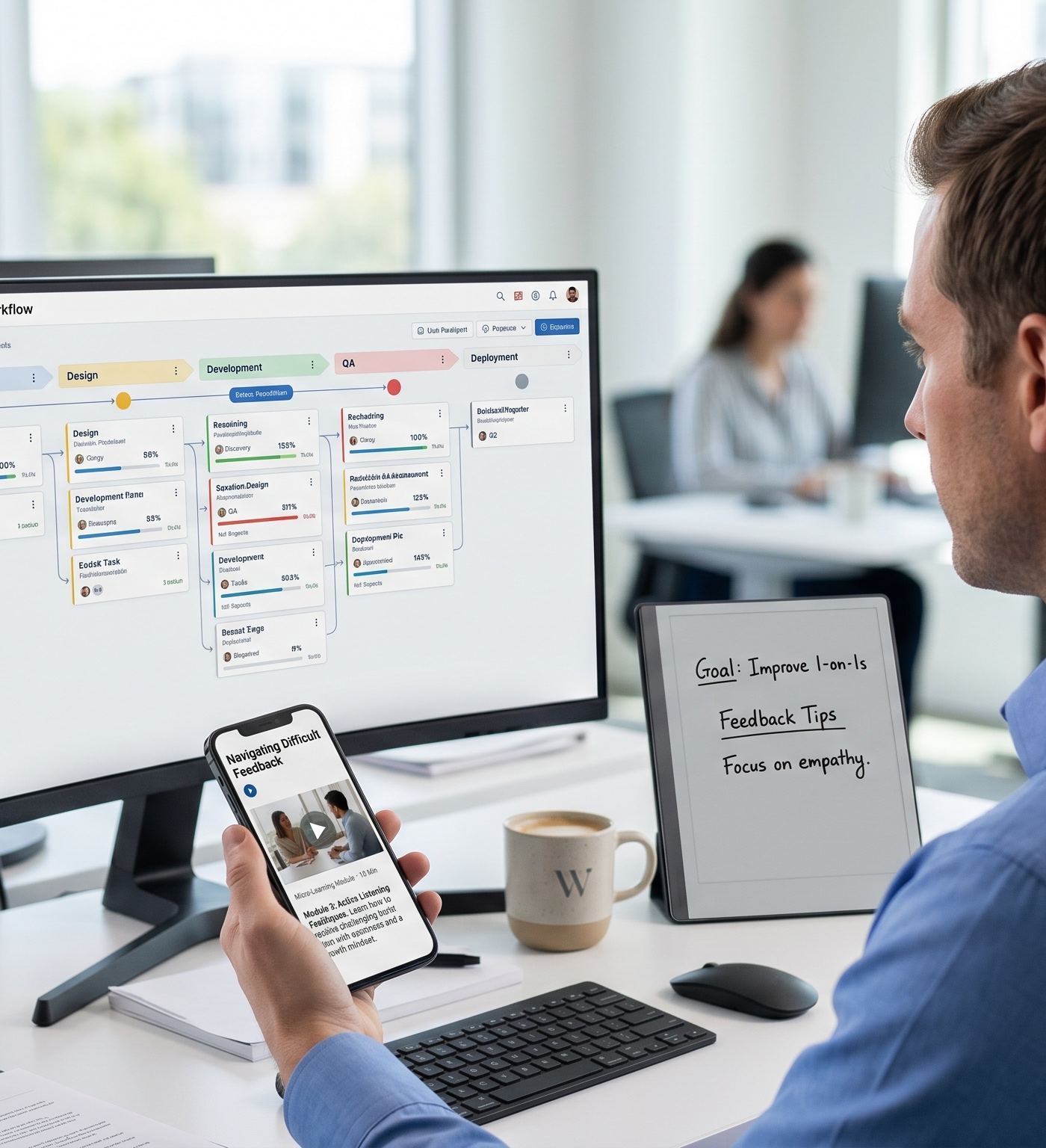
A manager about to give difficult feedback doesn't sit through a three-hour workshop on it weeks in advance. They pull up a 15-minute module right before the conversation. A new supervisor doesn't lose a day to leadership training. They pick up short lessons throughout the week and try the ideas out on real situations as they come up.
When learning shows up at the moment it's needed, it sticks differently. It's not abstract anymore: it's the thing you're about to do in five minutes.
Why Micro-Learning Took Off
A lot of this shift rides on micro-learning: short, focused lessons you can get through in minutes rather than hours.
That's not a quality downgrade. If anything, cutting the fluff usually makes the content more useful, not less. A 2024 study of first-year MBA students found that those who learned through short, focused microlearning modules scored significantly higher on learning performance than those taught the same material in a traditional format. A focused 30-minute lesson on handling a tense conversation will often land harder than a full day of material half of which never gets used.
People want learning that respects how little spare time they have. Companies want learning that actually changes how people perform, not just a tally of who showed up. Micro-learning happens to satisfy both at once.
Measuring the Right Thing
For years, the standard way to judge a training program was attendance: how many people showed up, how many courses got finished, how many certificates got printed.
None of that answers the question that actually matters: did anyone get better at their job?
That's the real shift happening right now: away from tracking what people were exposed to, and toward whether they can actually do something differently afterward. Good learning design today is less about cramming in information and more about helping someone solve an actual problem they're facing. Learning isn't the point. Getting better at the work is.
Skills Don't Last as Long as They Used To
The shelf life of a skill keeps shrinking. Something that felt essential five years ago might already be half-obsolete, thanks to new tools, new customer expectations, or a business model that's shifted under everyone's feet.
That makes treating learning as an annual event a losing strategy. It has to be ongoing: woven into the rhythm of work rather than scheduled once a year and forgotten.
Companies that build a real habit of continuous learning tend to adapt faster and innovate more. And it's not really about who has the smartest people anymore: it's about who learns the fastest.
This Is a Leadership Issue, Not Just an HR One
Making learning part of everyday work isn't something HR can pull off on its own. It depends on leaders.
The leaders who get this right build teams where curiosity is normal, where trying something new isn't punished if it doesn't work, and where a mistake gets treated as information rather than a failure to be hidden. They understand that developing people isn't a separate line item from performance: it's one of the main levers that drives it.
Teams led that way tend to handle change better and bounce back faster when things shift. In this market, that's a real edge, not a nice-to-have.
Technology Reset Everyone's Expectations
Mobile apps, AI tools, on-demand video: all of it has changed what people expect from learning. Someone can get an answer to almost anything in seconds now, whether that's a quick tutorial or a question typed into an AI assistant.
That convenience has made people impatient with the old way. Nobody wants to wait three weeks for a scheduled session when they need an answer today. Companies still leaning entirely on the old model are going to feel that gap widen.
So What Does This Actually Look Like?
None of this means workshops, coaching, and structured programs disappear. They still have a place. But they work better now alongside lighter, more flexible options that fit into an actual workday: short lessons, on-demand resources, peer learning groups, real-time support tools, ongoing leadership coaching.
The throughline across all of it is the same: less about one-off events, more about a habit. Less about consuming information, more about being able to use it. Less about checking a box, more about actually getting better.
Where This Leaves Us
The workplace has changed: people are busier, technology moves faster, and skills age out quicker than they used to. Pulling everyone into a room for a long training session just doesn't match that reality anymore.
The organisations that build genuinely capable, adaptable teams are the ones that stop treating learning as something separate from work and start building it into the work itself.
Because the best learning rarely happens in a classroom. It happens in the moment someone actually needs to know something, which is exactly the bet that learning in the flow of work is making, and exactly why the old model is losing ground.
Key Takeaways
- Before scheduling your next training day, ask whether the skill could instead be delivered as a short module people use right before they need it.
- Check how your team currently measures a training program's success. If the answer is attendance or completion, change the measure to a specific behaviour you expect to see afterward.
- Pick one process your team repeats often — onboarding, feedback conversations, performance reviews — and build one short, just-in-time resource for it this month.
- Ask your team what they actually look something up for in the moment, then build learning around that exact moment instead of a separate session.